
Home loans wihout the confusion
Whether you’re buying your first home, making your next move, refinancing or investing, we’ll help you understand your options and find a home loan that makes sense for you.
Straight answers. Smart options. No bank-speak.
What Are You Looking to Achieve?
At Wealth Connect Finance, we help clients across Brisbane and North Brisbane understand their borrowing options, compare suitable home loans and make informed decisions about their finance.
We’ll look at your circumstances, what you’re trying to achieve and what matters to you — then explain your options in plain English.
Buying a Home
Ready for your next move?Understand your borrowing power, purchasing costs and home loan options before you buy. We'll help you compare suitable lenders and manage the finance from application through to settlement.
First Home Buyers
Your first home, explained.Deposits, borrowing power, government schemes, upfront costs, pre-approval — there's a lot to learn. We'll take you through it step by step and explain everything in plain English.
Refinancing
Is your current home loan still working for you?We'll review your existing home loan, compare suitable alternatives and work through the costs and potential savings to see whether refinancing actually makes financial sense.
Property Investors
Finance for your next investment.Whether it's your first investment property or you're adding to your portfolio, we'll help you explore lending options and consider a loan structure that supports your plans.
Why Use a Mortgage Broker?
More choice. Less running around.
Going directly to a bank generally means looking at that bank’s own home loan products. A mortgage broker can compare suitable options from a panel of lenders, saving you from having to approach multiple lenders yourself.
We’ll consider your circumstances and compare suitable options based on factors such as:
- Interest & comparison rates
- Fixed, variable & split options
- Repayment flexibility
- Loan structure
- Upfront & ongoing fees
- Offset accounts & redraw
- Lending criteria
- Your future plans
You make the decision. We make sure you have the information to make it confidently.
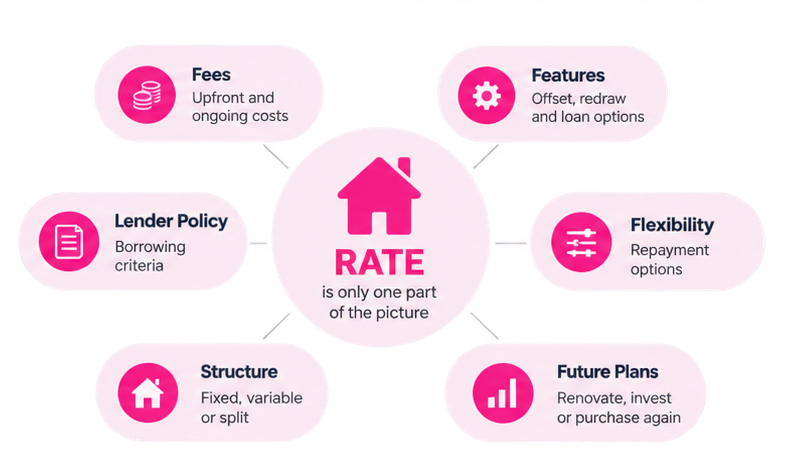
A Home Loan Is More Than an Interest Rate
The lowest advertised rate isn’t necessarily the most suitable home loan.
Fees, features, lender policies and loan structure can all affect whether a loan is suitable for your circumstances. An offset account may be valuable for one borrower but unnecessary for another, while a lender’s borrowing criteria may suit your circumstances better than another’s.
Your plans matter too. The way your loan is structured today can affect your flexibility if you want to renovate, refinance, invest or purchase another property later.
That’s why we look beyond the rate.
The aim isn’t simply to find you a home loan. It’s to help you understand your options and choose one that makes sense for your circumstances.
Understanding Your Home Loan Options
We’ll explain the differences and help you understand how each option works and which may suit your circumstances.
Fixed, Variable or Split?
A variable interest rate can move over the life of your loan, meaning your repayments may increase or decrease. Variable loans may also offer greater flexibility and features such as offset accounts or additional repayments.
A fixed-rate home loan gives you certainty over the interest rate and repayments for an agreed period, although restrictions may apply.
You may also be able to split your home loan, with part fixed and part variable.
Offset or Redraw?
Both can potentially help reduce the interest payable on your home loan, but they work differently.
An offset account is a transaction account linked to your home loan. The balance held in the account is generally offset against your loan balance when calculating interest.
Redraw generally allows you to access eligible additional repayments you’ve previously made into your home loan, subject to your lender’s terms and conditions.
Frequently Asked Questions
How much can I borrow?
Your borrowing capacity depends on a range of factors including your income, existing debts, living expenses, dependants, available deposit and the lender’s individual assessment criteria. Rather than relying solely on an online borrowing calculator, we can assess your circumstances and give you a clearer idea of what may be achievable.
How much deposit do I need?
It depends on the property, lender and your circumstances. While a 20% deposit can help you avoid Lenders Mortgage Insurance in many situations, there are lending options that allow eligible borrowers to purchase with a smaller deposit. First home buyers may also have access to government schemes or concessions.
What does home loan pre-approval mean?
Pre-approval gives you an indication that a lender may be prepared to lend up to a certain amount based on the information assessed at that time. It can help you establish your purchasing budget before you start seriously looking for property. However, pre-approval is generally subject to conditions and isn’t the same as unconditional loan approval.
Does it cost to use a mortgage broker?
Mortgage brokers are generally paid a commission by the lender when a loan settles. However, circumstances can vary, so any fees that apply to your situation should be disclosed and explained before you proceed.
How long does home loan approval take?
There isn’t one standard timeframe. It can depend on the lender, complexity of the application, valuation requirements and whether all required information has been provided. We’ll let you know what is required and keep you updated as your application progresses.
Should I choose a fixed or variable home loan?
Neither is automatically better. The right choice depends on your circumstances, preferences and plans. Some borrowers value repayment certainty, while others want greater flexibility. You may also be able to split your loan between fixed and variable portions.
Can i get a loan if I'm self-employed?
Of course, but the requirements are a little different to PAYG. You will need to be operating your business for a minimum of 2 years for the bank to consider that income.